September

September

Monday, September 6, 2010

Are the Older Women of the World too Rebellious???

I recently visited another country with my friend Kim, and we noticed an interesting phenomenon. We observed that there were several women with a variety of bright, almost shocking hair color.
You wouldn’t think that was a big deal if you saw a young woman who may like to express themselves through their appearance but these weren’t young women.

Very Maroon!

Purple on the bangs only
I would say at least ninety percent of these women were at least over 45-50 years old.
Violet color just in the front

I called this color "eggplant"
Orange with Maroon streaks
This really had us stumped because throughout my whole life, it seemed it was the younger generations that showed defiance through how they dressed and the outrageous styles of their hair.
Deep Purple...This picture doesn't so it justice!
So I am asking, what is the appeal of having strange hair color?
With older women, it can’t be to rebel.
Could it be they feel the need to stand out more than others?
Not just crazy color but crazy style!
And the winner is...for the brightest one of all!!!!
This one is hard to see but she has purple highlights throughout the hair
Are they desperate for the attention? It can’t be a style reason because sometimes the hair color clashed with the clothing they were wearing so it just looked awful! I don’t know, we couldn’t understand the reason. Any thoughts?

Monday, August 23, 2010

Only One English King Has Had the Title of "The Great"!

This is the first in my new series that I have entitled “Another Great Person From History”.
Statue of Alfred the Great as you enter Winchester

I love history, pretty much any kind but particularly English history. Probably because that is partly my history since the majority of my ancestors came from England. I recently took a week long class about Alfred(Ӕlfred is the Saxon spelling) the Great and I learned so much about this Man that I wanted to tell you about him briefly.
King Alfred

Alfred was born in Wantage England in 849. He was the 5th son of King Ӕthelwulf, King of the West Saxons. Ӕthelwulf’s kingdom basically included all of the southern part of England (on map this includes Kent, Sussex, Wessex, and Dumnonia (Cornwall).

Kingdoms at the time of Alfred's birth, before the Viking invasions began in earnest

Since he was the youngest of 5 sons, there was really no intention of him ever becoming King, so he focused on learning the art of warfare as a young man. However after the death of each brother, and the country facing the constant threat of Danish raids, he was picked to be the next King instead of the young sons of his brothers.

Because he was not intending to become a king, he felt that as a king:

“a king ruled not only over a land and its people but through them. They had been entrusted to him by God so that he might through them ‘virtuously and worthily administer the authority’ committed to him” (Alfred The Great by Richard Ables).

He was crowned King on April 23, 871, succeeding his brother Ӕthelred, after demonstrating his leadership qualities in his role as second in command to his brother. He was a religious man, he also believed in military power and led his troops against the Viking invaders three times. In 876 the Danish leader, Guthrum led an invasion into Wessex that forced Alfred and his troops to flee. During the next 2 years he gathered troops throughout his kingdom and in 878 he again faced and defeated his Danish invaders with a deciding victory at the Battle of Edington. As part of the peace treaty, Guthrum was to be baptized. In 886, Alfred negotiated a peace treaty with the Dane which divided the country geographically into 2 kingdoms, the “Danelaw” and the Kingdom of the Anglo-Saxons.

Map of England after the Danelaw is established by King Alfred.  His Kingdom included Wessex and Mercia. 

Now that peace had, for the most part, been established, Alfred did not sit around but instead began to build the most progressive defensive system ever know to England. He began organizing his army and built a series of well-defined “forts” know as Burhs (pronounced “burr's”). He implemented this in 3 phases. Phase one, was by using already existing sites that had defensive walls in place. Most of these were former Roman forts or fortified towns. Our class visited one of these burhs that is still standing today in Portchester, England.
Inside the Roman Walls of Portchester that King Alfred used as one of the burhs.
Me, outside the burh at Portchester.  The tower behind me was added during the Medieval period.

Phase two, was to strengthen existing defensive structures and add new walls around exsisting towns. This included the Roman town of Winchester, and phase three, was to build new burhs and towns. After these were built and fortified, his people were never more than one day away from protection if there was another invasion. He also divided his army into two parts so that the soldiers took turns being on duty.
Map of the locations of the larger burhs established by King Alfred for defense of the country


Like many great leaders throughout history, King Alfred was a strong believer in "Peace through strength".
Once the country's defenses were in place, King Alfred then focused on increasing the education and spirituality of his nobles. He had always felt that the Danish invasions were a result of the wickedness of his nobles, so he brought in religious men to teach the Gospel and to educate his people.

1st-Site of an Abbey that was built at the time of King Alfred.  2nd is the lower level of the Palace built by King Alfred but destroyed by Oliver Cromwell (yuck, gag) after the Civil war in 1651.  Only the Great Hall (below) is left from the time of King Alfred.

As King, he also implemented a code of law that established justice and order, and reformed the coinage system. He had a biographer chronicle his life, and he also personally participated in the translation of books from Latin into Anglo-Saxon. He had the Anglo-Saxon Chronicles written, so we have quite a lot of information about the Anglo-Saxon period because of this.

Winchester Cathedral
 (Medieval, the Anglo-Saxon Cathedral that Alfred had built was replaced by this larger Cathedral on the same location.)

He reigned until his death in October, 899 at the age of 50, and was buried in Winchester.
(***I hope I got all this history correct.  My notes were a little sloppy so if I am wrong about anything, please leave a comment and let me know.  Thanks!)

Friday, August 20, 2010

For Lasagna, Who Needs Electricity? All You Need is the Sun!

I have told you about the great product called the Solar Hot Pot, and for those of you who live in places where there is an abundance of sun, like here is AZ, it will save a lot of money on your electric bills. I recently made a recipe called “Skillet Lasagna” that has been a family favorite for years, but instead of heating up the kitchen using the stove top, I thought I would try it in the Hot Pot on the pool deck and see if it would work.


In the morning I browned the Ground beef and onion (recipe is at the end of the post). Then I added half a jar (2 cups) of spaghetti sauce. Use your favorite brand, any one will work. I use sauce that I make and bottle here at home. After it is mixed in I put the meat mixture into the hot pot. Now this next step is different than the recipe but I then layered the cottage cheese, then the noodles (uncooked), and topped it with the Italian spices, the can of crushed tomatoes and the remainder of the spaghetti sauce.

I covered it and place it into the reflector that was set up on a table on our pool deck. Now I just had to watch it and rotate it to follow the sun about every 30-45 minutes. After 4 hours, I topped it with the shredded mozzarella cheese and let it cook for an additional 15-20 minutes or until the cheese has melted.

It turned out perfectly! The noodles were cooked to perfection and it tasted great.

If you don’t want to invest in a Solar hot pot, I have seen instruction online about how to make your own homemade version so try it out if you want to experiment before buying one. Although I promise, once you try it you will love it!

Here is the recipe for the Skillet Lasagna:

Skillet Lasagna
1 pound ground beef
¼ c. chopped onion
1 16oz can diced or crushed tomatoes
1 quart spaghetti sauce
1 ½ t Italian seasoning
12oz cottage cheese
2 c. uncooked egg noodles
16oz shredded mozzarella cheese

Brown beef and onion, then drain. Pour tomatoes and Italian seasoning over meat. Layer cottage cheese, noodles and spaghetti sauce over meat and tomatoes. Simmer, covered, for 20-25 minutes until noodles are soft. Last minutes, sprinkle cheese on until melted.

This is the site that I bought mine at:  www.solarovens.net/ 

Friday, August 13, 2010

Mingling with the Stars in London

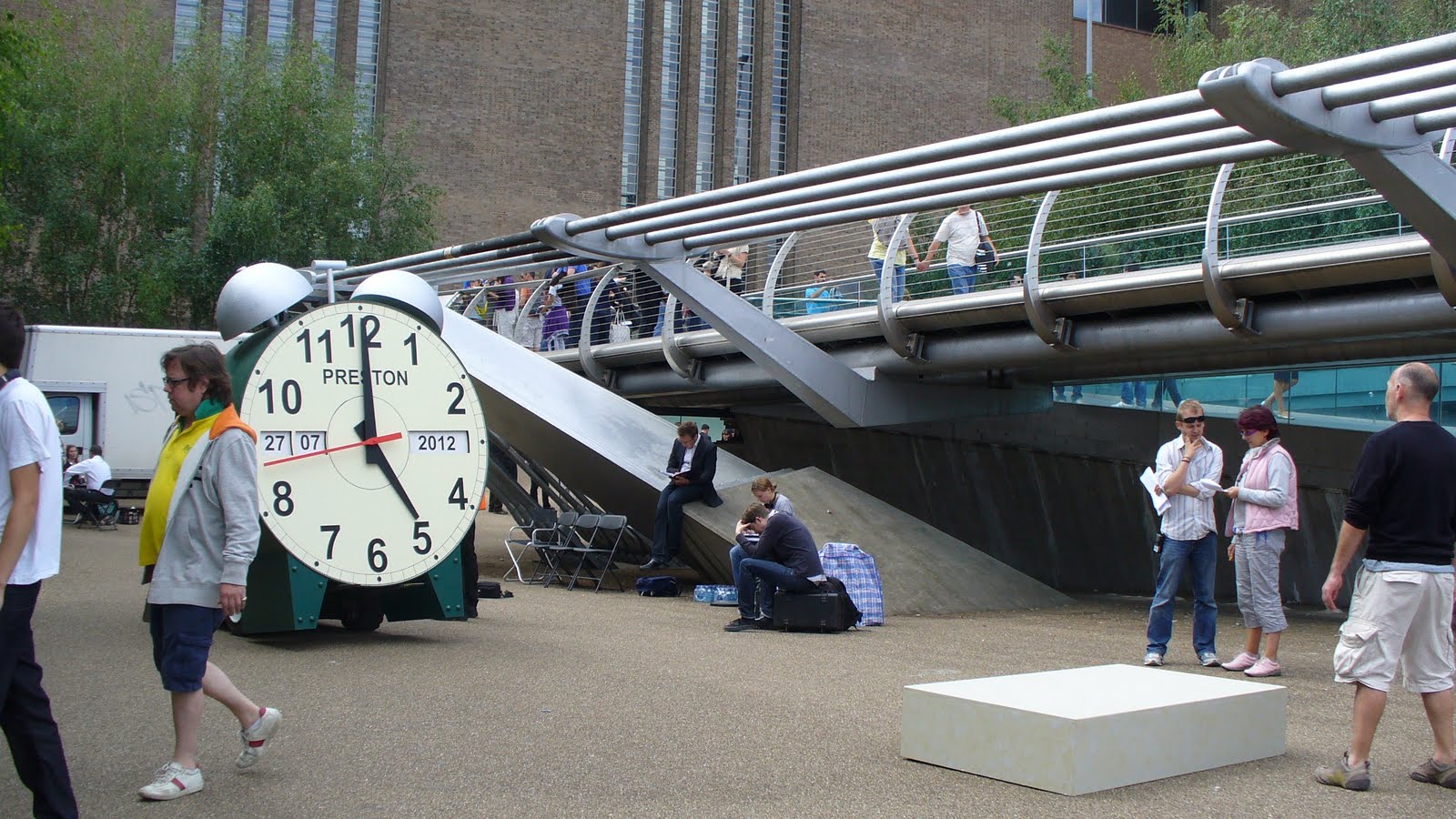
As mentioned in my last post, I have recently been to England and Belgium and had THE perfect trip! One of the highlights was accidently coming upon a movie being shot in London. I was on my way to the Globe Theater, to talk with the Gift Shop manager about selling a line of Shakespeare related charms in their store, when, just coming off the Millenium Bridge (or as the Americans keep calling it, “the Harry Potter bridge”),

I saw a film crew setting up a scene for a picture the BBC is making. I love movies so I stopped to watch a little of the process.

I started looking around and I suddenly I saw an actor that I recognized as Hugh Bonneville,

one of my FAVORITE English actors.

He looked like he was going over lines while waiting for the scene to be ready,

so I asked one of the employees that was assigned to keep the public at bay, if she would take a business card I had and ask him for his autograph. I explained that I was visiting from Arizona and he was a favorite of mine. She said sure and took the card and pen back to him. They spoke for a minute and he looked in my direction and to my amazement, he started coming out to meet me.

He was so nice! I introduced myself and told him I really enjoyed his work and he asked if I was visiting or what, so I was able to explain about our trip to Oxford and about my line of Shakespeare charms that I was trying to sell. I asked about the movie they were working on which is entitled “London 2012” and he explained to me a little about what it is about. We joked that I wouldn’t get to see it for about 2 years after it is released because that is about how long it takes for English movies to make it to America. He was even nice enough to have his picture taken with me also.


Although I had many amazing experiences on this trip, and yes, you will be hearing about many of them in the coming weeks here, I would have to say that this was in the top 5 of the exciting things that happened on this trip.

Hugh Bonneville is not only a really good actor he is a really nice man and now he is officially my favorite English actor (See updated favorites list in the side bar!). Sorry, Rupert, Richard, Colin, James, and Ben. (Hugh Jackman doesn’t count since he is Australian).

Some of my favorite Hugh Bonneville movies are:

Notting Hill


Mansfield Park (1999)


Miss Austen Regrets


Lost in Austen
and Daniel Deronda


…plus many others. Check him out!!!

Wednesday, July 21, 2010

I'm Leaving on a Jet Plane....

Just a heads up, I am leaving for 2 1/2 weeks so I won't be posting anything until I get home.  Hopefully, I will be able to post something along the way but I never know.

I'll catch you up after August 9th.  Don't miss me too much!!!!  My friend Kim and I are going to be attending classes at Oxford University and also visiting Belgium.  So excited!!!  Later!
Here I come!!!!

Tuesday, July 20, 2010

Don't You Just Love Great Mystery???

Maisie Dobbs is a private investigator in post WWI London. In the seventh book of the Maisie Dobbs series entitled “The Mapping of Love and Death”, the author Jacqueline Winspear, I feel, recaptured some of the spark that seemed to be lost in the 2 previous books of the series. Although books 5 and 6 were good to read, I just didn’t like them as much as the first four.


This book opens with a prologue chapter that starts in 1914, when Michael Clifton learns of the war in Europe starting while he had been in California surveying some property he had just purchased. He immediately sets off for England instead of returning home to Boston and his family, to fight in the war. He felt an allegiance due to the fact that his father had emigrated from England as a young man.

Chapter one jumps us to present day, which is April 1932. Maisie, who has now been in business for herself for a few years, and her associate, Billy, are keeping busy with various cases. She has just received a letter from a doctor she had met and worked with as a nurse during the War several years previously. Dr. Hayden is informing her that he had referred an elderly couple he knew from Boston to look her up in order to investigate the death of their son Michael Clifton, who they had believed had been killed during the war, but now further evidence had surfaced that suggests he may have been murdered instead. Maisie has the tough job of trying to solve a 17 year old murder mystery without too much evidence, but being the Amazing sleuth that she is, she does get to the answer and also finds other answers to other problems along the way. One warning, there is a sad goodbye to a main character in this one that has been in all of the books, but it is ok.
Jacqueline Winspear
Winspear does a good job with the mystery but I especially like these books because there is the great side story of Maisie’s personal life and all that is going on in it. It is like reading 2 books at once. This is not a “who-done-it” type of mystery; you aren’t fed clues throughout the book to try to figure it out on your own. Instead the author keeps some clues very vague until she tidily wraps it up at the end. The characters that are in her daily life sometimes help in moving the mystery along but, if they aren’t involved in the mystery, they are fun to get to know on their own or just to see what is happening in their lives during this book.

You also get to learn a little more about WWI which tends to be a side theme in all of these books up to this point and will probably continue until 1939 when England is pulled into WWII. One other side note, there is a very promising romance in this one. Maisie has “teased” us a few times but I think this one is a keeper, hopefully!

If you haven’t read any of the Maisie Dobbs mysteries, I suggest you start with the first one which is entitled “Maisie Dobbs”, and work your way up to this, the 7th book of the series. I have enjoyed all of them.

Friday, July 16, 2010

Don’t be caught in a natural disaster without a few of these filled up!!!

On all of the emergency preparedness sites, one of the main things that is suggested that you have on hand is a small amount of cash, 5-7 days worth. Not only do you need the cash but you need it in small denominations.

Let me explain why.

During any natural disaster, the first thing to go is electricity. Now, if you don’t have electricity, you can’t get money at the bank or any ATM’s, or you can’t purchase anything from stores without the exact cash on hand.  This means, if you need water food or batteries, you could be paying more than it is worth if you don’t have the right amount of cash. I saw this in England 3 years ago while visiting. There was a terrible flood when the Thames over flowed and many villages were completely cut off. The stores had to start rationing water, so you were only able to get 2-3 flats. Since there was no electricity, many flood victims had to pay 20 pounds, for 2-3 flats of water which would normally have only cost around 10-12 pounds. And that is assuming the smallest bill you had was a 20.  The same thing happened during Katrina and numerous Earthquakes. 

Therefore, it is recommended that you keep 1’s, 5’s, and 10’s in a stash at your home. So the question arises, where is a safe place to keep 5-7 days of cash at home? Here is one answer. They are called Diversion Safes. You just unscrew them and put the small bills inside, close them and put them on the appropriate shelf.  There are many different products that you can choose from to hide you cash stash in. Here are a few choices:


I have even seen cans of vegetables, soups, fruits, just about anything you could find in a grocery store.  Just “google” diversion safes, and find the best price, or here are a few sites that I have found:

www.amazon.com/s/ref=nb_sb_noss?url=search-alias%3Dtools&field-keywords=diversion+safes

http://selfdefenseproshop.com/products.php?cat=54 

www.personalsafetyshop.com/WBCATE?PMCTNO=0000000026&PMVMOD=R

www.einvestigator.com/spy_equipment/hidden_diversion_safes.htm 

Keep a few in different places in your home and most important, remember where and what they are. We had a visitor once who tried to open an A&W root beer but it wouldn’t open and he couldn’t figure out how or why. He eventually realized what it was but he was disappointed at not being able to have a root beer. It was funny!

If you don’t want to purchase a diversion safe, find a safe place to keep you store of cash. It is so important!!